
EY has a numbers problem. Nearly 400,000 recent college graduates apply for jobs at the global consulting giant every year. 30,000 are selected for personal interviews. Only 5,000-8,000 are hired.
It’s a large cut. And EY knows they are missing people who could be superb employees. But how do you give that many candidates a fair chance when there is no human-scale way to evaluate each and every one?

Photo: Pexels, Mart Production
For a long time, the honest answer was that you couldn’t. Applicants from the Ivy League and other elite schools showed up at interviews bearing impressive academic resumes. They knew how to run case studies, a critical part of the EY vetting process. And they had inside knowledge that only a well-connected alumni network can offer.
The leadership at EY knew this advantage was unfair. More importantly, they understood that graduates of community colleges and state schools were equally capable. These students just lacked training or practice in consultancy interviewing. “We really needed to get away from the perfection of a resume and start looking at potential,” said Ginnie Carlier, EY Americas Chief Talent and Culture Officer.
To level the playing field—to give each candidate the same access to preparation and knowledge—Carlier turned to an EY-built conversational avatar named Coach Eve, and a small cohort of artists-in-residence working with EY’s Intelligent Realities Lab.

EY Americas Chief Talent and Culture Officer (Photo: EY)
EY’s Intelligent Realities Lab
Domhnaill Hernon is the brainchild of EY Intelligent Realities and its unusual partnership with the arts. It’s an association that he first explored at Nokia Bell Labs, where he resurrected their legendary Experiments in Art and Technology (E.A.T.) program. After moving to EY, he adapted that model of artistic and engineering co-creation to a new group called the Cognitive Human Enterprise and Metaverse Lab. More recently, Hernon’s team has evolved into EY’s Intelligent Realities Lab.
Building on its metaverse work, the Intelligent Realities Lab’s focus is EY’s WeVerse, a company-wide virtual world that supports the entire talent experience, from campus recruitment through onboarding and employee wellbeing. As the digital face of EY’s hiring efforts, Coach Eve is the part of the WeVerse that outsiders interact with the most.
Just a few years ago, a college graduate applying for a job at EY might have received a printed booklet or been directed to a web page that tried to anticipate their questions about EY’s culture and working environment. But those materials would have been incomplete and not at all responsive.
In contrast, Coach Eve is made for interaction. Grounded in EY’s custom knowledge base, Eve leads candidates through practice questions, simulated case studies, and even addresses their concerns about dress code or what EY looks for in a new hire.
In one early test, an intern spent ten minutes asking Coach Eve about the difference between EY’s pension and 401(k). That’s the kind of practical and detailed question a nervous applicant might never ask in an interview. But the answer might also be what convinces a talented person to accept an offer—or apply in the first place. “The psychological safety piece is so important to us,” said Carlier. “When a student or candidate comes in having had that live interaction [with Coach Eve] the conversation is much more elevated.”
Why do candidates feel comfortable asking revealing questions and practicing interview skills with an AI avatar? Some of it is generational. Students graduating today were already using chatbots in high school—they’re used to that kind of interaction. EY also makes it clear that candidate chat histories are never saved. A recruiter doesn’t get to see that information; it’s purely for the candidate’s benefit. But a more understated reason is that every aspect of Coach Eve has been considered and designed to put a candidate at ease, by engineers and by artists.
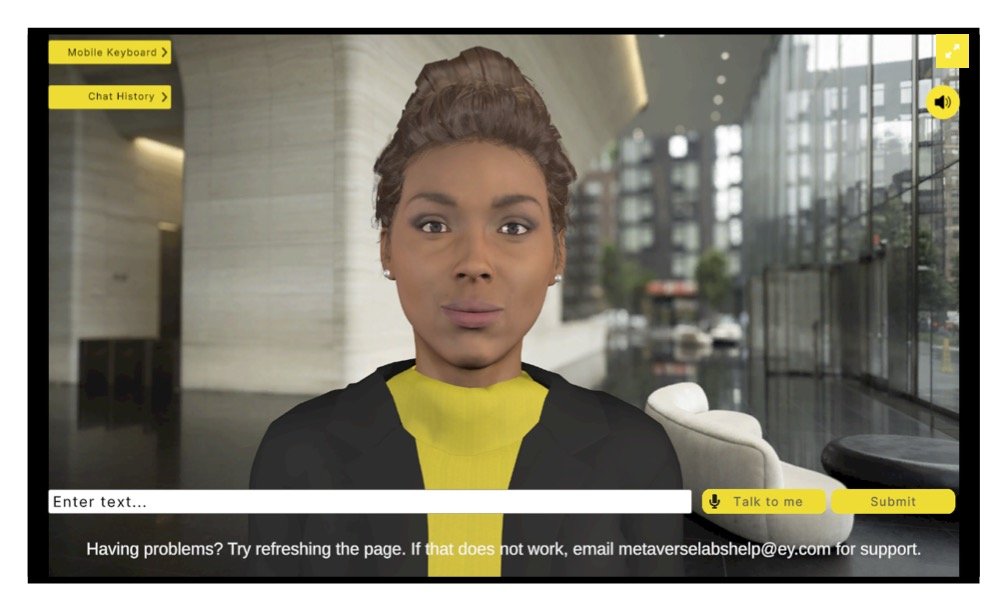
The AI chatbot, "Coach Eve," is a creation of the EY Intelligent Realities Lab. (Photo: EY)
Where the Artists Come In
EY’s Intelligent Realities lab is grounded in the arts. There are 20 full time creative technologists in the lab, engineers who primarily specialize in 3D animation and modeling. But Hernon also has a long relationship with NEW INC, the New York City based New Museum’s talent incubator for artists working in design, technology, entrepreneurship and culture. As the corporate sponsor of NEW INC’s Extended Realities (XR) track, EY has access to the most promising members of that program. Of the roughly dozen NEW INC technologists EY supports every year, a smaller number become Intelligent Realities artists-in-residence and end up working closely with Hernon and his team.
That close relationship between EY technologists and the artists-in-residence has helped make Coach Eve relatable, a tool candidates feel comfortable with. It’s why they open up to it, why they ask it questions they’re afraid to ask an interviewer, and why the experience feels less like interacting with a chatbot and more like regular conversation.
Lisa Jamhoury is one of those artists. She creates performances and installations at the intersection of the human body and technology. The project she’s been working on with EY’s Intelligent Realities Lab, called “Revival,” immerses the participant in a 20-minute interaction with a chatbot trained on embodied cognition research. A movement sensing camera watches the body; a stethoscope senses the heart. Her goal is to help us realize how important our physical experience is to our intelligence, and how distinct that is from machine intelligence. “I want people coming out of this to ask, ‘What is it to be inside my body?’” said Jamhoury. “‘What is it to move my body? What is it to move within an environment? And finally, what is it to interact with others?’”
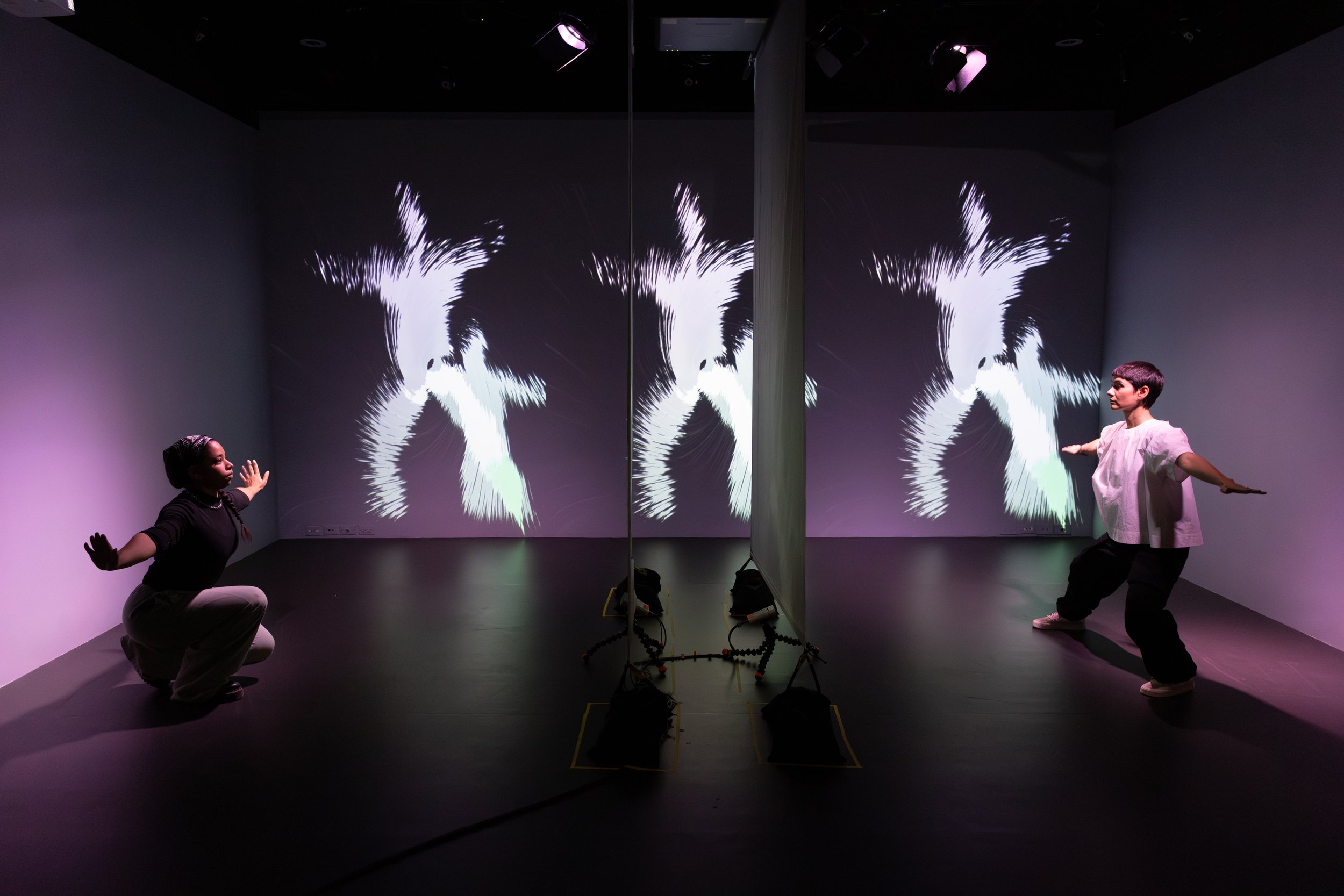
EY artist-in-residence Lisa Jamhoury (right) playtests a new work sync : mirror with EY Creative Technologist Danielle McPhatter (left) at Playtest 001 at Onassis ONX (Photo: Whitney Browne)
This might seem overly philosophical—and not applicable to the kinds of design and user experience (UX) decisions that inform a corporate chatbot. But for Hernon and his team, working with artists who ask open ended questions has had a measurable impact.
Consider the problem of response time. Even after extensive engineering, Coach Eve would take about three seconds to reply to a question—a delay users felt was uncomfortable and unnatural. After conversations with their artists-in-residence about how human beings sense the duration of events, the team changed Coach Eve’s behavior. When a candidate asks a question, the avatar now tilts its head and enters a brief animated pause, as if pondering what was asked. That beat consumes about 1.5 seconds, cutting the perceived latency nearly in half. “Time is relative,” explained Hernon. “You have little tricks that you can play to change the perception of time. And that insight came from working with our artists.”
Or what about Coach Eve’s appearance? The avatar is not photorealistic, even though the technology exists to create that impression. Eve presents as more of a stylized icon—a decision that was also influenced by the team’s artists-in-residence.
When multimedia artist Josie Williams began her residency with EY in 2022, identity and representation was central to her work, especially in a project called Ancestral Archives. Over several years, Williams and the team explored how avatars modeled on West African masks were able to avoid the uncanny valley, that unease people feel when something almost-human turns out not to be.
So even though hyper-realistic avatars are possible with today’s technology, the Intelligent Realities Lab decided to go against current trends and keep Coach Eve visibly digital. Interacting with this avatar, candidates can practice case studies without feeling judged. And they can make mistakes and ask naive questions—as many times as they want.
Similar to Ancestral Archives, current EY artist-in-residence Jazsalyn, who goes professionally by one name, is defining Ancestral Intelligence as a framework through her practice. An Afro-Carolinian artist and technologist, Jazsalyn is a recently announced winner of the 2026 State of the Art Prize from the Creative Capital Foundation. With EY’s team, she’s been exploring alternate AI futures through Ancestral Intelligence Network: Echolocation, recently showcased at DEMO2026 and presented by NEW INC and New Museum.
“I grew up watching a lot of sci-fi and seeing it as a speculative form of storytelling, of seeing your way into the future, of shaping that future and realizing its power,” Jazsalyn explained. “Black sci-fi writers like Octavia Butler saw the responsibility to tell stories as a warning—this could be our potential future if we don’t take another path. I feel like I’m carrying on that lineage in my own work.”

Jazsalyn. Ancestral Intelligence Network: Echolocation. 2026. (Photo by Azelion Manuel)
The Translator in the Middle
For artist-corporate collaborations to produce results, someone has to speak both languages. With his long experience managing these programs, Hernon takes on that responsibility. But he is always looking for other translators—artists who understand corporate goals and culture, and businesspeople who understand the value of the arts.
In 2025 Josie Williams was hired as a member of Hernon’s team. “They were looking for someone who knew Python, and I’m quite well versed in that realm,” said Williams. “But I don’t think about technical things in the same way as my peers. Especially when we’re talking about responsible AI, I always like to think about the larger picture. Who is this impacting? Are we talking to them? A lot of people will say ‘Keep humans at the center’ but then they’ll make something that automates the very thing a person does.”
Now an AI Engineer at EY, Williams is the first artist-in-residence to transition into a full-time role. Her regular work involves building AI knowledge bases for EY’s clients, but she also serves as vital connective tissue between the lab’s engineers and the current artists-in-residence.
“I’m on the other side now,” said Williams about her new position at EY. “An artist is telling me their big dream and I’m like, oh man, that’s such a great idea. I’m not entirely sure how we’re going to make it happen, but we’re going to figure it out.”
Hernon is direct about what happens without that translator function. “The language artists use is very different,” he explained. “You might be the most gifted person who could profoundly change a business, and no one will know because they literally can’t understand what you’re saying.”
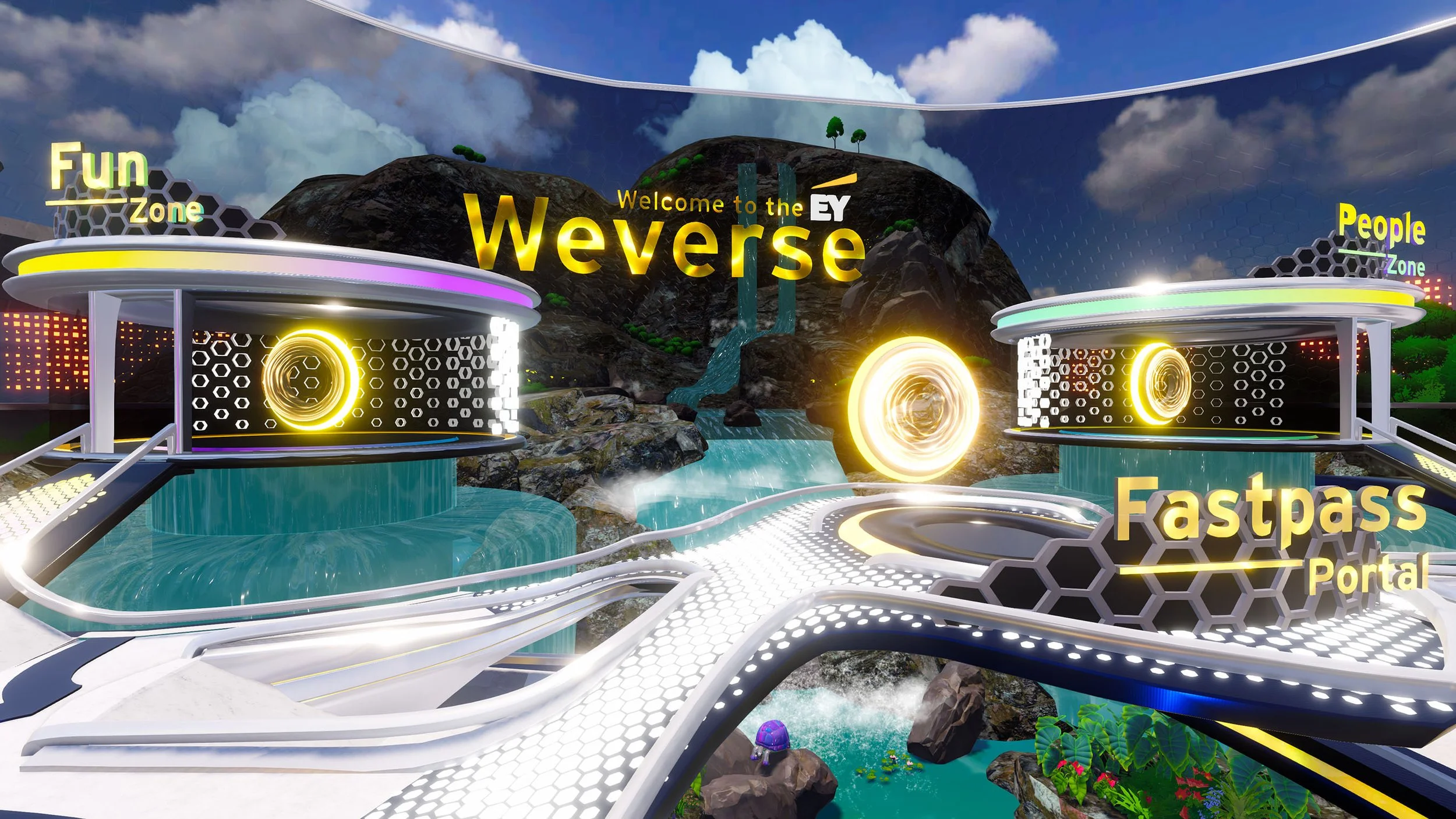
EY's WeVerse, the generative AI-powered virtual world, was the 2024 winner of Work Life's "Best Use of Gamification in the Workplace" award. (Photo: EY)
Protecting Human Capital
Technology that brings together sensitive humans and intelligent machines will always be fraught, especially in consequential arenas like a job interview. That’s why having people with different professional and life experiences working together to build it is so important.
As companies like EY move into the agentic era, where employees are going to be managing teams of people and machines, they’ll need to keep larger goals in sight, beyond mere speed or efficiency.
“As a leader, how do I effectively use that agent and that human to bring out the best solution? AI can accelerate how we do our work, but humans are still shaping the why. I’m a firm believer in that,” said Carlier, when asked if she is worried that employees risk losing their human compass.
Her colleague, Joe Depa, EY’s Global Chief Innovation Officer, added his own perspective. “Human decisions—especially the ones that require ethical judgment—can’t be delegated to a machine,” he said. “We need curiosity and empathy to craft good prompts, interpret outputs thoughtfully, and spot issues a machine might miss. Without those human skills, AI simply won’t be aligned with real-world needs.”
Is it necessary to have a poet or artist’s input when building a chatbot? Not really. These days, an AI tool like Claude Code, Codex or Copilot can spin one up all on its own—no humans in the loop. But the Intelligent Realities Lab at EY would argue that engineering alone is not enough, especially now. The stakes are too high.
I asked artist Lisa Jamhoury if her performances or creative insights have a utility beyond inspiration, and if that matters.
“Is art useful or is it just inspiration?” she responded. “I would say that inspiration is incredibly useful. The best products come from inspiration and something new. The best work is inspired work”
—
Published here on Forbes.com
June 29, 2026
