
Image credit: Pexels
On November 25, Warner Music Group and Suno, the AI music creation service, announced a settlement of their ongoing legal dispute along with an agreement to license Warner’s catalogue as source material for Suno’s AI generation. Just a few days earlier, Warner and Udio, Suno’s competitor in the AI music space, announced their own settlement and agreement. These two deals not only resolve an almost 2-year legal battle, they set a model for similar agreements between other major recording labels and AI companies. (Sony Music and Universal Music Group have yet to settle their respective lawsuits with Suno and Udio.)
While heralded by the labels as artist-empowering agreements, the announcements were not without criticism. Facing an expected torrent of licensed AI-generated music, emerging artists, in particular, are concerned that their tentative foothold in the marketplace will be further eroded.
Lost in the arguments and counter-arguments, however, is an opportunity for another marginalized group to gain legal access to empowering creative tools. Disabled artists, rarely seen as serious creators, are increasingly using this new technology to express themselves and show up in the market.
Generative AI tools empower disabled users
Stephen Lovely is a blind musician who has used Suno to create three albums of songs. In a recent interview, Lovely shared how Suno and other generative AI tools have opened up creative worlds to him that would otherwise have remained closed. “The sky is the limit now with this technology, and I love hearing other people’s creations,” said Lovely. “Eventually what we do is going to become mainstream. It’s going to be very normal.”
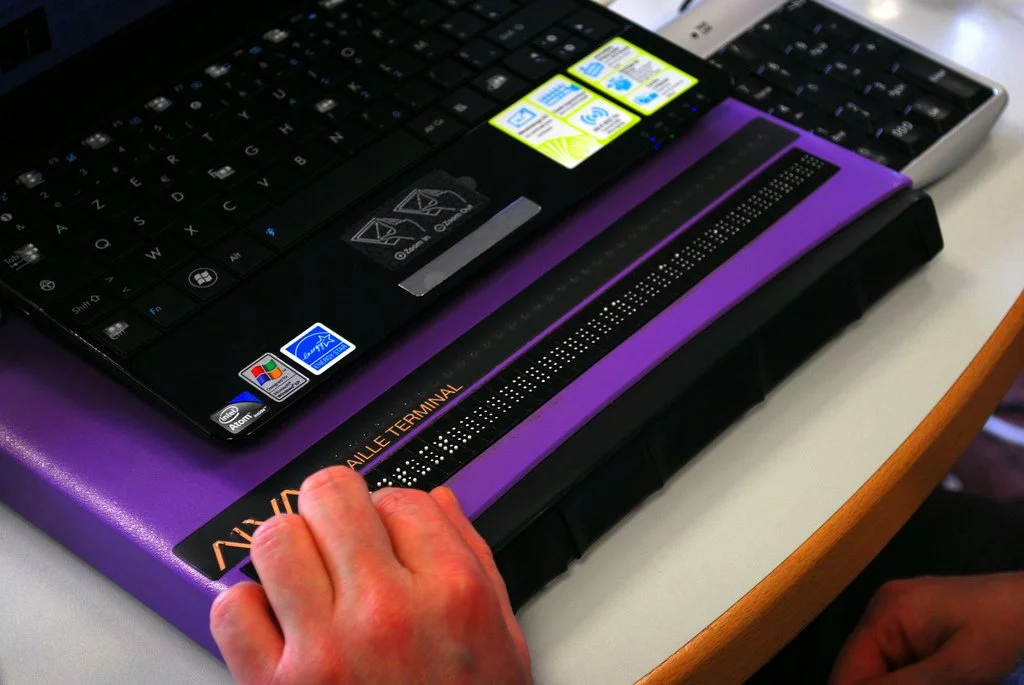
Right now, these generative AI apps are not equally accessible to disabled creators; some do better than others. While not perfect, Suno has made much of its interface compatible with screen readers, according to Lovely. (A recent review of Suno by the American Foundation for the Blind pointed highlighted where the app excelled in accessibility and where it needs to improve.)
Sebastien.delorme, CC BY-SA 3.0, via Wikimedia Commons
AI and machine learning for real-time collaboration
Academic researchers are also using AI to expand the creative possibilities for artists with other disabilities. A team at Nottingham University was recently recognized for their work on an embodied-AI system that makes it possible for disabled and non-disabled musicians to collaborate and improvise in real time. The award-winning project, called Jess+, brought together a violinist and cellist from Sinfonia Viva, a UK-based orchestra, with Jess Fisher, a disabled musician who has pioneered the use of many assistive technologies.
For everyone involved, it was the collaborative nature of this project that broke new ground. Music is as much a social as creative act, and a tool that allows disabled and abled performers to share their art as equals was enthusiastically welcomed.
Outsider art and creation—a model for the music industry?
But disabled musicians have been contributing for many years—even centuries—before the advent of generative AI. What is known as “outsider art” has a long tradition of bringing in perspectives that are beyond the mainstream, critical additions to our shared cultural history.
That full diversity of human creation was something that the NASA team led by astronomer Carl Sagan wanted to emphasize when they curated the musical selections for the Voyager Golden Record in 1977. This 12-inch metal disc, affixed to both Voyager spacecraft, will remain playable for well over a billion years should an alien civilization discover it wandering the vast reaches of the Milky Way.
How do we share what moves us as human beings? What parts of our living experience do we want to send out to the stars and eternity? Carl Sagan’s team chose music from across civilizations and around the world—Javanese Gamelan, Senegalese percussion, Indian ragas, and a Navajo chant among others. But the final musical selections on the disc communicate something even more essential about who we are and who we can be. Blind Willie Johnson’s “Dark Was The Night” and Ludwig van Beethoven’s “Cavatina” from his Opus 130 string quartet (composed when he was completely deaf) were created by musicians who birthed unforgettable art, despite the most profound constraints.
Do generative AI tools enhance our creativity or reduce it? Do they minimize effort and hardship at the expense of individuality? We are going to be asking those questions a lot in the next years and decades. But for disabled artists this is an age of possibility. Though a tiny share of their user base, the major technology and music recording companies should pay attention—they are a model for the rest of us.
—
Published here on Forbes.com
December 8, 2025
